Some notes on my recent, sudden, improvement in mood

Two days ago, I went from feeling listless and unmotivated to feeling more or less like my usual self, quite suddenly. I’m not sure what caused this and I want to capture some of my hypotheses for latter pattern matching.

How I was feeling

On June 14th, I sent the following message to some of my friends:

I’m kind of in a weird place. I’ve been saying that I’m pseudo-depressed, but I’m not sure if that’s a good expression.

I’ve been sleeping a lot, sometimes more than 12 hours a day. In particular, I seem to be alternating, day by day, between getting up at 7:00 AM and getting up at noon.

I feel relatively unmotivated. Things mostly don’t seem worth doing. Like, I imagine setting a serious intention to do something, and part of me asks “why though? what good thing will result from this?” and I don’t have a good answer. Everything I want doesn’t exist?

Duncan was disappointed and concerned that I didn’t seem to have “a deal” any more. I don’t have anything to live for.

That said, I mostly don’t feel particularly or actively unhappy.

And,

  • I’m doing a pretty good job of exercising every day.
  • I’ve been meditating every day, and I’ve been sinking pretty deep into it.
  • I usually write something or program something every day. I’m getting a little bit done, but not very much.
  • I’m only eating between 2:00 PM and 7:00 PM, except for liquid food.

Earlier in this month, I was pretty distracted / dopamine addicted, and I successfully weaned that off.

I woke up at noon again today, and thought “ok, something weird seems to be happening with me”, and thought that it seemed prudent to maybe loop other people in on what’s going on with me.

I think I’m only going to be happy if I’m working hard, but at the moment, I don’t really feel the point. I’m currently just plugging along anyway, and maybe I’ll get some momentum + attempting to dialog with my desires.

Of course, it might be an entirely non-psychological thing. Maybe I should try eating a little bit of meat, as an experiment, and see if that helps. I might also go to another city for  a few days. Open to other suggestions for experiments, I guess, though I might wrinkle my nose at some of them and say no.

I’ve been feeling like this for at least a month, arguably all the way back to when I was in Taiwan in May.

A shift

Then two days ago, on June 27th, I had a pretty abrupt shift.

My notes from that day

  • 18:23 – I’m feeling notably, specifically happy. #[[phenomenological naturalism]]
    • I started while I was mindlessly browsing twitter a few hours ago (as I have been doing a lot over the past few days). I remember seeing something that was funny, that made me laugh. In laughing I felt good.
    • Later, I noticed a feeling of warmth around my heart.
    • I lay down with my eyes closed for a while, and continued to feel the feeling around my heart.
    • This is markedly different from how I have been feeling (unmotivated, listless).

Since then, I’ve been feeling basically like my normal self, able to get momentum on stuff.

Causes?

What happened?

I still don’t know. Here are some possibilities.

  1. It was something that I ate? I’ve been at home more and RGI less since I got back from Taiwan. I’ve been eating more eggs and more carbs, and less kale, than I often do.
    • On the 27th, I ate:
      • I ate a Quinoa bowl with vegetables (including carrots and zucchini and some others).
      • I ate some of Bulgur bowl with vegetables (including green beans, and some others)
      • I ate a bobos chocklate chip bar.
      • I ate a bunch of Made Good rice crispy bars. [Note I had been eating a lot of these over prior days]
      • I ate a bunch of pure organic fruit strips
        • I did note that these had a very strong taste.
      • I drank a Gatorade.
      • I ate some chocolate chipMade Good granola minis.
    • Could the vegetables have made the difference? The Quinoa? It seems like the next time I’m feeling bad or lame, I should just try varying my diet and and if that shakes something loose.
  2. Creatine made the difference? I recently bought some creatine monohydrate supplements in gummy form. Those arrived on the 24th, and I’d been munching on them throughout the 25th, 26th, and 27th. This is probably 5x more creatine than I usually take in a day, and much more than I’ve been taking recently. Possibly that made the difference?
  3. Other supplements made the difference? I haven’t been taking my standard supplement stack since I got back from Taiwan (because it was a arguably-trivial inconvenience to repack all my pill containers). But on the 25th, 26th, and 27th, I took my current stack of
    • I think,
      • Morning, empty-stomach pills
        • Korean Panax Ginseng
        • Inositol
        • Alpha Lipoic acid
        • Taurine
        • CDP choline
        • L-tyrosine
        • Creatine
      • With a meal pills
        • Bacopa
        • Ginkgo Biloba
        • Alpha GPC
        • b12
        • vitamine
        • Vegan EPA + DHA
        • Creatine
    • Could that have been it? It seems unlikely, because I wasn’t taking those supplements for very long before I started feeling lame. I was taking all of those for less than 2 months (I think), before I was interrupted by travel)
  4. Earlier that day, I was thinking about deciding to be happy. I didn’t quite get to the point of committing to it, in that moment, but the way I was feeling it out felt real. I could imagine just deciding that I was going to be happy or deciding to to have high energy, because life is just better if I’m happy / high energy, that it is basically a free variable, that I could just decide to be one way or another.
  5. I had decided the night before that I would start trying to cowork with people for 4 hours in the mornings, to build momentum. I am doing that (I’m typing this essay in a coworking session!), though I only barely did that on the 27th, around noon, for around an hour. That seems unlikely.

Investing in wayfinding, over speed

A vibe of acceleration

A lot of the vibe of early CFAR (say 2013 to 2015) was that of pushing our limits to become better, stronger, faster. How to get more done in a day, how to become superhumanly effective.

We were trying to save the world, and we were in a race against Unfriendly AI. If CFAR made some of the people in this small community that focused on the important problems 10% more effective and more productive, then we would be that much closer to winning. [ 1 ]

(This isn’t actually what CFAR was doing if you blur your eyes and look at the effects, instead of following the vibe or specific people’s narratives. What CFAR was actually doing was mostly community building and culture propagation. But this is what the vibe was.)

There was sort of a background assumption that augmenting the EA team, or the MIRI team, increasing their magnitude, was good and important and worthwhile.

A notable example that sticks out in my mind: I had a meeting with Val, in which I said that I wanted to test his Turbocharging Training methodology, because if it worked “we should teach it to all the EAs.” (My exact words, I think.)

This vibe wasn’t unique to CFAR. A lot of it came from LessWrong. And early EA as a whole had a lot of this.

I think that partly this was tied up with a relative optimism that was pervasive in that time period. There was a sense that the stakes were dire, but we were going to meet it with grim determination. And there was a kind of energy in the air, if not an endorsed belief, that we would become strong enough, we would solve the problems, and eventually we would win, leading into transhuman utopia.

Like, people talked about x-risk, and how we might all die, but the emotional narrative-feel of the social milieu was more optimistic: that we would rise to the occasion, and things would be awesome forever.

That shifted in 2016, with AlphaZero and some other stuff, when a MIRI leadership’s timelines shortened considerably. There was a bit of “timelines fever”, and a sense of pessimism that has been growing since. [ 2 ]

My reservations

I still have a lot of that vibe myself. I’m very interested in getting Stronger, and faster, and more effective. I certainly have an excitement about interventions to increase magnitude.

But, personally, I’m also much more wary of the appeal of that kind of thing and much less inclined to invest in magnitude-increasing interventions.

That sort of orientation makes sense for the narrative of running a race: “we need to get to Friendly AI before Unfriendly AI arrives.” But given the world, it seems to me that that sort of narrative frame is mostly a bad fit for the actual shape of the problem.

Our situation is that…

1) No one knows what to do, really. There are some research avenues that individual people find promising, but there’s no solution-machine that’s clearly working: no approach that has a complete map of the problem to be solved.

2) There’s much less of a clean and clear distinction between “team FAI” and “team AGI”. It’s less the case that “the world saving team” is distinct from the forces driving us towards doom.

A large fraction of the people motivated by concerns of existential safety work for the leading AGI labs, sometimes directly on capabilities, sometimes on approaches that are ambiguously safety or capabilities, depending on who you ask.

And some of the people who seemed most centrally in the “alignment progress” cluster, the people whom I would have been most unreservedly enthusiastic to boost, have produced results that seem to have been counterfactual to major hype-inducing capability advances. I don’t currently know that to be true, or (conditioning on it being true) know that it was net-harmful. But it definitely undercuts my unreserved enthusiasm for providing support for Paul. (My best guess is that it is still net-positive, and I still plan to seize opertunities I see to help him, if they arise, but less confidently than I would have 2 years ago.)

Going faster and finding ways to go faster is an exploit move. It makes sense when there are some systems (“solution machines“) that are working well, that are making progress, and we want them to work better, to make more progress. But there’s nothing like that currently making systematic progress on .

We’re in an exploration phase, not an execution phase. The thing that the world needs is people who are stepping back and making sense of things, trying to understand the problem well enough to generate ideas that have any hope of working. [ 3 ] Helping the existing systems, heading in the direction that they’re heading, to go faster…is less obviously helpful.

The world has much much more traction on developing AGI than it does on developing FAI. There’s something like a machine that can just turn the crank on making progress towards AGI. There’s no equivalent machine that can take in resources and make progress on safety.

Because of that, it seems plausible that interventions that make people faster, that increase their magnitude instead refining their direction, disproportionately benefit capabilities.

I’m not sure that that’s true. It could be that capabilities progress marches to the drumbeat of hardware progress, and everyone including the outright capabilities researchers moving faster relative to growth in compute is a net gain. It effectively gives humanity more OODA loops on the problems. Maybe increasing everyone’s productivity is good.

I’m not confident in either direction. I’m ambivalent about the sign of those sorts of interventions. And that uncertainly is enough reason for me to think that investing tools to increase people’s magnitude is not a good bet.

Reorienting

Does this mean that I’m giving up on personal growth or helping people around me become better? Emphatically not.

But it does change what kinds of interventions I’m focusing on.

I’m conscious of deferentially promoting the kinds of tech and the cultural memes that seem like they provide us more capacity for orienting, more spaciousness, more wisdom, more carefulness of thought. Methods that help us refine our direction, instead of increase our magnitude.

A heuristic that I use for assessing practices and techniques that I’m considering investing in or spreading: “Would I feel good if this was adopted wholesale by DeepMind or OpenAI?”

Sometimes the answer is “yes”. DeepMind employees having better emotional processing skills, or having a habit of building lines of retreat, seems positive for the world. That would give the individuals and the culture more capacity to reflect, to notice subtle notes of discord, to have flexibility instead from a the tunnel vision of defensiveness or fear.

These days, I’m aiming to develop and promote tools, practices, and memes, that seem good by that heuristic.

I’m more interested in finding ways to give people space to think, than I am in helping them be more productive. Space to think seems more robustly beneficial.

To others

I’m writing this up in large part because it seems like many younger EAs are still acting in accordance with the operational assumption that “making EAs faster and more effective is obviously good.” Indeed, it seems so straightforward, that they don’t seriously question it. “EA is good, so EAs being more effective is good.”

If, you, dear reader, are one of them, you might want to consider these questions over the coming weeks, and ask how you could distinguish between the world where your efforts are helping and the world where they’re making things worse.

I used to think that way. But I don’t anymore. It seems like “effectiveness” in the way that people typically mean it is of ambiguous sign, and actually what we’re bottleneck on is wayfinding.


[ 1 ] – As a number of people noted at the time, the early CFAR workshop was non-trivially a productivity skills program. Certainly epistemology, calibration, and getting maps to reflect the territory were core to the techniques, and ethos. But also a lot of the content was geared towards being more effective, not being blocked, setting habits, and getting stuff done, and only indirectly about figuring out what’s true. (notable examples: TAPs, CoZE as exposure therapy, Aversion Factoring, Propagating Urges, GTD) To a large extent, CFAR was about making participants go faster and hit harder. And there was a sense of enthusiasm

[ 2 ] – The high point of optimism was probably early 2015, when Elon Musk donated 10 million to the future of life institute (“to the community” as Anna put it, at my CFAR workshop of that year). At that point I think people expected him to join the fight.

And then Elon founded OpenAI instead.

I think that this was the emotional turning point for some of the core leaders of the AI-risk cause, and that shift in emotional tenor leaked out into community culture.

[ 3 ] – To be clear, I’m not necessarily recommending stepping back from engagement with the world. Getting orientation usually depends on close, active, contact with the territory. But it does mean that our goal should be less to affect the world, and more to just improve our own understanding enough that we can take action that reliably produces good results.

Some sleep thoughts very roughly

My current model: falling asleep depend on three things happening. If these three things happen, then you will be asleep:

  1. Relaxed body
  2. Lowered pulse (around 50 bpm)
  3. Mind clear of thoughts (or leaning into visual imagery)

But actually, most of the action is in the prerequisite 0th step: disengaging from whatever is interesting, so that your attention can actually be to relax and fall asleep.

How to do that?

Some ideas:

  • IDC with the thoughts
  • Physically remove the felt senses from the body
  • Meditate?
  • Distract yourself
    • By drawing
    • By reading fiction
    • By trying to get absorbed in some thoughts?
  • “Leaning out” from the thoughts?
  • By jotting down everything that you’re excited about?
  • By scheduling specific time in the morning to try and boot up those motivating considerations / making reminders of everything important.
    • The main thing, might be the sense of time scarcity or urgency which is salient at the time.


Modes, not traits, and decoupling cognitive energy from intentionality

[Epistemic status: speculation from single n of 1 experiences that I’m excited about]

I had a really effective second half of my day today, and right now I’m going to speculate about some of the mechanics of that.

Modes, not traits

Some relevant background to this is a thought that I had two weeks ago:

“I shouldn’t think of terms in terms of ways that I should be or things that I should do, but rather __modes__ that I could get into that are useful sometimes. Even if I want to be in those modes most days, I should still think of them as separate modes and not as default states.”

This is important because a lot of ways that I want to be consume some resource, so I can’t actually maintain them perpetually. I might want to be habitually hyper-productive, but since I probably can’t be hyper-productive for literally all of my waking hours (I need rest and stuff), if I try to always be hyper productive, I’ll fail, and never really build the habit. Instead, I should have a hyper-productive mode and build the habit of  getting into that mode regularly.

This is maybe obvious to a lot of you, but it seems like a useful insight to me. (I wonder if I’m on the verge of reinventng “work/life balance” in the same way that I reinvented “its good to have a room.”)

I think this goes pretty deep, and there are a number of different not-necessarily mutually exclusive modes at various levels of subtlety. (For one thing, I have a mode for syncing with Anna: our natures tend to clash by default, but these days she either meets me in something like my way of being, or I meet her at something like her way of being.)

But here are three high level, high granularity modes / ways of being / high-level intentions that it seems like I would want to operate from on a regular basis.

  • Rest
  • Executing intentions mindset / committed engagement [manager time]
  • Slow thinking / deep work / mono-focus [maker time]

The rest of this post will be about holding the Executing intentions mindset.

Maintaining taughtness

My current sense of how to do the Executing Intentions mode well, involves maintaining “taughtness” / “tension” across the whole period that you’re in that mode. That’s a phenomenological description: it feels like there’s a sort of tension that I can let go slack. It has something to do with remembering the executing intentions meta-intention? Or having the context of the tasks that I’m doing loaded up and available?

One reason why this worked well today, I think, was that I decided that I was going to stop listening to audio-books for the time being. I might usually listen to an audiobook as I walk somewhere, but this tends to take me out of the EI mindset, what was taught becomes slack.

Other ways that I can fall out of it:

  • Looking at my phone in the bathroom.
  • Making food and eating, and especially listening to audio while making food.

Each of these have a character of “I’m doing this mundane thing right now, I might as well occupy my mind with something entertaining or informative.” It might be that that engagement with that material kicks out the EI meta-intention, because my mind is filled with other content. But it feels more like all of those behaviors have a kind of lackadaisical attitude, like “its fine to slow down and spend time here”, instead of the momentum of one thing after another.

I did take breaks today, but they had a different character than most breaks I take. They were more intentional: more circumscribed, less distracted. I intentionally decided how long each one was going to be, and set a timer, but more importantly than the timer, there was a part of me that didn’t turn off during the break, I was still geared up to take the next thing coming at me. I’m confident this is less restful than other kinds of breaks, and thus it is crucial that this is only a mode and that one also have a rest mode, when you release all the tension and taughtness.

Decoupling energy levels from intentionality

Another thing that happened today is that at the end of my session, I was feeling cognitively drained. I think that usually, that would cause me to disengage from the EI mindset and release my conscious hold on my intentionality. But this time, I was more like “I notice that I am cognitively drained. My job in this time-slice is to recover cognitive energy.” and I went to go strength train.

I think there’s something important here: I was decoupling how tried I felt from how intentional I was going to be.

This seems important on a number of counts

  • For one thing it caused me to strength train during my work day, which sometimes gets skipped.
  • Additionally, this sort of rolling with the punches enabled me to maintain the taughtness, instead of abandoning the attitude whenever I loose cognitive resources.

Remember, this really depends on having high quality rest.

Physiological arousal / activation / agitation

Separately from aversions, there is excess physiological arousal. [1]

Sometimes, even when I’ve pretty successfully processed some felt sense, and am riding it out, there’s still stress involved. For instance, when I’m drafting an important email, to a potential employer or potential romantic partner.

This kind of arousal isn’t always bad. Often the energy of this kind of heightened state is positively useful. But high arousal usually correlates with less stable attention. And, often, this high level of arousal causes me to bounce off my work.

Oftentimes this happens just after I finish something stressful. In this case, it will often feel hard to transition to the next thing, instead opting to go for a walk around the neighborhood (for 40 minutes to an hour, usually). The high levels of activation is “left over” after sending the email, and it accordingly feels effortful to put direct my attention toward something else.

This doesn’t seem bad, calming down and returning to a baseline (and maybe doing psychological processing at the same time?) seems like a natural thing to do. But also, that bouncing off is one of the main ways that I loose time in my day, and it seems like there ought to be way to do drop that arousal much more efficiently.

Some thoughts:

  • I could maybe just take this as my trigger to go exercise for the day, and turn the excess energy to a productive purpose, while also stabilizing my physiological arousal level.
    • Having a quick, intense exercise routine seems helpful for this. I was jumping rope for a while, but that apparently didn’t stick.
  • I could just set a ten minute timer and slow down my heart rate, by breathing slowly?
  • Remember my feet?
  • I could do a physical relaxation routine. [This feels wrong in that it’s like setting up a counterforce against the agitation, and having them conflict. It seems like a better thing would not feel like that.]
  • I could try removing the felt sense from my chest. [That feels bad and clugy.]
  • I have some idea that regular meditation is supposed to improve this stability of this variable. So that if I was meditating more regularly, I would return to baseline more rapidly and easily? I don’t know if that’s true.
  • Meditators do a thing sometime, where they break a thing down into its component sensations. Do that?
  • Maybe I should do Focusing to this as well? That seems hard. “This” is slippery.
  • Ok. Well another theory is that this is just the same thing exactly as the felt sense / unhandled concern situation, and not “left over” at all. Like I’m feeling agitated because I don’t know what the response will be, and its important, even if it is out of my hands. This suggests that I should dialogue with the thing about whether it is actually out of my hands?
  • Singing


[1] Just to note, you can have high arousal due to some aversion or concern that has not been processed. In fact, that is probably even more common. But in this section, I’m only discussing high-levels of activation that are not associated with an aversion or unprocessed yank.


Full productivity outline

[epistemic status: Tentative. A lot of observation and iteration has gone into this, but it is still probably wrong or misarticulated in some important way.]

This is a followup to, and update of The Basic Intervention Set for Productive Flow, and That, Generalized. In the days after I wrote that post, I mulled over the confusions I note there, and made a new diagram.

But this is also an almost complete outline of my full productivity system. Over the past few months (or longer, depending on how you count), I’ve been writing a something-like-a-book on the Psychological Principles of Personal Productivity. I think this post capture upwards of 80% of that something like a book. [1]

Overview

Basically, almost everything that I understand about how to achieve stable personal productivity is summed up in the this diagram:
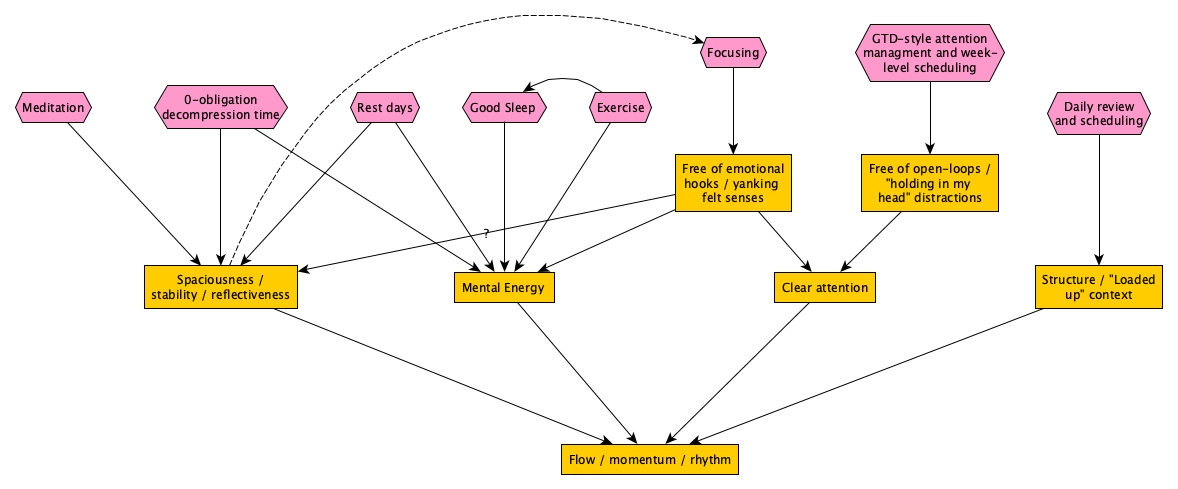
2019-12-07 ontology of phenomological states that contribute to flow (with interventions) v.2b

The yellow boxes represent phenomenological states. I’m sure that each one could be grounded out in neurology or physiology, but I’m not concerned with that (at least right now, in this post). Each one can be thought of as an an axis that compresses detailed information about one’s mental and emotional state.

The pink hexagons represent interventions or intervention sets.

So pink is actions you take, and yellow is goals you hit.

I claim that the four main major state-targets (Spaciousness/ stability / reflective, Mental energy, Clear attention, and Structure / “loaded up” context), are, to a first approximation, both necessary and sufficient for sustained personal productivity. If you have all of these, then productive flow is automatic, if you’re missing even one, things break down, and making progress becomes a struggle.

Therefore, if you structure your life such that have / embody those states by default, and have systems that automatically return to them as set points, when there is drift or disruption, then productive flow becomes automatic.

So in this essay I’m going to outline each phenomenological target, and the interventions that are relevant to it. [Probably each of the interventions deserve their own page, with implementation details, but I’m not going to try for that in this version.]

Caveats

Note that virtually all of the content in this post comes from first person n of 1, phenomenological observation and experimentation. Your Mileage May Vary. In fact, since I no one but me has tried to implement this system, I have almost know idea how idiosyncratic to me it is. I can imagine people who work really hard, and effectively achieve their goals with a quite different internal setup. But this one is designed to make exertion automatic and frictionless, sidestepping the need for internal force. To me, at least, it seems principled, not just effective.

A note on choosing goals

This system is sufficient for getting to productive flow, the state of maintaining high, regular, levels of focus and effort, with the automaticity of water flowing downhill. Maximizing your personal work efficiency.

But that is not sufficient for productivity, that is actually creating value.

The biggest factor that determines a person’s productivity is which problems they choose to work on. It doesn’t matter how efficient you are, how much of yourself and your resources you bring to bear on your work, if your work doesn’t matter.

Productivity = usefulness of work * efficiency of work

So all of the following needs to be put in the context of the huge caveat: Most of your productivity has already been determined by the time you’ve decided on a project. Don’t neglect that step! Figure out what the best thing to do is (or at least which things are in the running for “best”), and only then focus on improving your efficiency.

[Eli, I’m talking to you.]

Clear attention; clear internal, physical/emotional space

In brief, this phenomenological state equals “not distracted.” In order to do deep work, you need to have a clear mental space, so that you can actually commit your full attention to the relevant task. Otherwise, your attention will be pulled this way and that, and you won’t be able to have any deep thoughts.

I’m going to break this overall state down into two components, though in practice the two are interrelated, and on reflection the distinction between them may be unprincipled.

That is, clear attention entails “no mental loops held in memory” and “no emotional hooks.”

Free of mental open loops and niggling thoughts

Here, I am referring to the issue of “holding open loops on the brain” described in detail in David Allen’s Getting Things Done.

[quote GTD?]

In order to clear mental space to focus on the things that you care about, your other concerns and commitments (to yourself and others) have to be stored in a trusted system. Something like a GTD system is essential.

I still remember the immense feeling of relief I experienced the first time I processed all my inboxes. I had had a background sense of not being on top of everything, of not knowing which things I needed to do, what items I hadn’t seen yet, and which one’s had slipped through the cracks and I’d forgotten about. After getting to full inbox 0, that background anxiety evaporated.

You want to be on top of everything that you need to do, in that way, consistently. Sometimes things slip and you find you have more things coming at you than you can track and process, and that’s ok, but this should be a trigger (one of several) for a self regulating system that brings you back to that kind of control. [2]

The actual book Getting Things Done is an excellent resource for this, and I highly recommend it, though virtually everyone I know has needed to adapt its principles into a personalized system, rather than adopting the GTD-system proper, outright.

The other practice in this space that seems to make a big difference, and is similarly accompanied by a palpable sense of relief when I do it, is weekly(ish) scheduling.

(I say weekly(ish), because I’ve lately been experimenting with structuring my life in chunks larger than 7 days: 15 days as an upper bound).

Once every week or so, I make sure to take a few hours and outline the upcoming span on my calendar, scheduling workshops, full focus days, task days, rest days, Deep work blocks, and meetings. [Here is the current version of my span-scheduling checklist. Scheduling a bunch of things is an overwhelming combinatorics problem, and having a checklist really helps. Every time I get confused, I just go back to the last unchecked thing.]

At least for me, I almost always have a bunch of priorities that I care about making progress on, too many for me to manage in my head. This gives rise to a kind of anxiety about not hitting everything that I care about. I’m committed to all of them, and so they interfere with each other: it’s hard to dedicate my focus to any one goal, for an extended period, and sink into deep work, because I’m agitated the other things falling by the wayside. I’m wanting to make sure that everything happens, so by default, everything tries to happen at once, which prevents much of anything from happening. Like Mr. Burns’ diseases.

When I schedule my week, this allows me to sequentialize those parallel processes, such that each one trusts that it will be taken care of in due time, and I can give my full attention to one thing at a time. [Another example of an internal agreement]

Free of “emotional hooks” and unprocessed reactions

The more important class of internal disruptions though, is unintegrated emotional responses, often in the form of anxiety or something like it. (The category of “unintegrated emotions” need a good name.)

For instance,

  • I’m agitated because some part of me is expecting something painful to happen.
  • I feel activated because I have a partially formed idea that I want to put to paper, and I’m afraid that I’m going to loose it.
  • I’m triggered and defensive about something that’s happening.
  • I feel generally “urgy” and compulsive, with no superficially obvious reason why.
  • I’m distracted, thinking compulsively about my romantic situation, at the expense of much else.
  • I’m anxious that something is going to slip through the cracks, or I’m going to drop a ball.
  • I’m agitated that I’ll actually be able to do enough math to acquire the math competencies and/or that it will be a boring slog.

All of these involve some part of me that is holding some concern, which in someway distracts or disrupts from highly focused attention. [3]

As I said, these all fall under David Allen’s definition of “Open Loop”, but they differ from the connotations of that phrase in a few ways. For one thing, these ones seem more visceral than “remember to bring in my laundry.” For another, it is often (but not always) much less clear, on the face of it, what the thing is “about.” Also, with these kinds of emotional hooks there’s usually a little pain in the mix, too, which incentivizes flinching away from the thing.

With things of this category, simply offloading them to an external system is probably not sufficient. The part of me holding the concern will continue pulling at my attention and/or affecting my physiology. Sometimes, rightly so, for the concern maybe urgent, higher priority than what I would otherwise be doing, it might be relevant to what I’m doing doing, or if I put the painful/difficult thing out of sight for now, I might continually avoid thinking about it, and not come back to it.

The important thing is that all of the yank at my attention, (or, if not yanking in a particular direction, cause my attention to be generally jumpy).

One major category of unprocessed concerns are Aversions. Aversions are a big deal. My impression is that most of people’s problems with “Akrasia”, “motivation”, and “procrastination” are fundamentally about aversions to their work. (I think this is usually the case, even when there aren’t physiological tells, and when there isn’t an obvious aversive element.) Everything else can be going amazingly, and an Aversion can stop me cold in my tracks, killing my momentum.

Therefore, the most important strut of this whole system is using Gendlin Focusing to process and integrate aversion and other emotional “yanks”. This is so important that it needs to be reliable, both in the sense that there is ~ zero friction to applying it, and in the sense that it works when I apply it. I’ve been working on both of those over the past 3 months.

Very briefly…

My Focusing practice involves a number of different moves that are relevant depending on the specifics of the situation. The core idea is to get to the heart of the thing that’s bothering me, expressing it in its own terms. Sometimes simply articulating the thing cause it to resolve itself. Other times, it gives me footholds into doing debugging, crafting  plans, or making internal agreements that the relieve the concern.

A lot of my work is contiguous with doing Focusing: I start out doing the introspection, but this blends into taking action in the moment. Often I’ll act from the the felt sense, letting it steer.

Often action is what’s needed, but sometimes what’s needed it closer to grieving or acclimating to a new expectation (set point) about reality, but some part of me is blocking that, because it seems painful. “Letting reality in”, produces relief. I’ve sometimes pondered that all anxiety is has some dishonesty at it’s core: their either something that you’re trying to reject, or something that you’re trying to project falsely to others.

(I metaphorize that as a vesicle that’s tense, holding something inside, but if you puncture the membrane, the surrounding cytoplasm can get in and the chemical levels equalize. The anxious pressure comes from holding on to something which is not in equilibrium with the world.)

I speculate that in addition to a dialogue practice like Focusing, this overall system needs some way to, gently, top-down, reduce physiological arousal. These felt senses often come with activation, and the activation itself can be distracting / make it harder to make progress on the problem. This is certainly not always the case, often that anxious energy, when properly focused, is super useful. But also, sometimes the most useful thing for me to do in a given moment is take a nap, or to calm down.

I’ve been exploring a few methods in this area, including controlled breathing, and direct manipulation of the felt sense.

Some extra only-kind of related stuff near this category

Expectation of distraction

The two sections described above are relevant to clearing your attention, but there’s at least one other thing that can kill my ability to focus: the expectation of a physical interruption.

This has been discussed at length, but it bears repeating: if you’re trying to do deep work, you need to be in a context that some less-than-conscious part of you expects will not be disturbed.

Dealing with particularly attention grabby things

As an aside, there are a number of stimuli that are attention suckers, like social media, youtube, webcomics, etc.

I find that if I’m engaging with any of these, it is usually because there’s an aversion that I’m flinching away from. (This is also true of TV. If I’m watching TV, that’s a flag that some part of my system has broken down.) But also, they sometimes come up in the natural course of doing stuff.

I’m generally advocating a pretty internal alignment flavored philosophy in this post. I think it is pretty important (and more effective in the long run) to not disown any of your goals. But often the appropriate response is environmental. In this case: block the fuckers.

Personally…

  • I have blocked both xkcd and Saturady Morning Breakfast Cereal, my distractions of choice.
  • I’ve blocked the youtube feed and recommender sidebar, but I can still use youtube. This is great, because I periodically want to watch a video for any number of legitimate purposes, but it also prevents me from falling into a loop of dazedly watching clip after clip for hours.
  • Similarly, I’m using newsfeed eradicator for facebook.
  • It would be great if there was I way that I could search my email inbox, without seeing the new email that’s at the top (maybe I can bookmark a link that’s just to my read messages? Apparently, you can search for just read emails, an I could use that to bookmark a link. Success!)
    • There are also ways to open blank email to send without viewing your inbox.

Some behavioral interventions that are in this vein, but that I haven’t really got a hang of yet…

  • Keeping track of the various pseudo-adictive things, and learning to notice the flavor those urges, so I can be more reflective about them. Things like, “see what’s on my phone”, “check my financial account”, “see if anyone messaged me back on okcupid.” Most of these should have a policy: you check them exactly once a day or once a week, or whatever, with a set trigger (like when you get an email in your inbox.)
  • Separating out work that involves searching for information on the internet. Currently, I’ll be doing something, think that I should look something up or see what google says and go do it immediately. But this inevitably turns into a low-value time sink, as I get distracted by all kinds of stuff in the same general area as what I am looking for, and it kills my momentum. A thing that I could imagine doing instead is writing down all of these task, and doing them only after I’ve finished everything else. I haven’t implemented this though, so [shrug].

Psychological Energy

I think most people know what I’m pointing at when I use the word “energy”. Sometimes I have my work laid out in front of me, and I’m free of distractions and…I find it hard to get out of bed. Or sometimes, I know what would be best to do next, and the thought of it is exhausting, and I feel like I have to force myself to do it. In contrast, sometimes pushing hard feels easy (insofar as that makes sense).

Technically, I define psychological energy as “the willingness or propensity to exert cognitive effort” (“cognitive effort”, having its own technical definition). I don’t have a clear enough understanding to know for sure, but I think that it might make sense to think of one’s energy level as the regulator on cognitive effort.

Having ample mental energy is crucial. Some people try and power through life with will power (a loosing proposition most of the time), but if you cultivate your mental energy, you won’t have to force, exertion flows from you easily [modulo the considerations about aversions, and whatnot].

Mental energy seems to break down into, or be predicted by two factors: physical well being, and outlook.

Note that I’ve spent some time looking into the academic literature on mental energy and fatigue, but the following is not that. The following sections, like the rest of this post, are based on my own n of 1 phenomenological investigation and experimentation.

Physical well-being

If you find yourself low on mental energy that could be because of purely physiological factors.

Sleep

Most notably, not getting enough sleep. My ability to function seems particularly sensitive to sleep deprivation, but the cognitive costs of lack of sleep are well documented.

For this reason, a system for stably good sleep is among the most important interventions in this set. [Write a page outlining my suite of interventions on sleep.] It’s hard to get to 100% reliability, however, so it is good to have the ability to compensate for disruptions by taking naps. [Write a page on my updated nap-protocol.]

One re-frame that’s been useful for me: I think of sleep as something like “renewing my connection to the Force.” This seems pretty connotationally correct to me. When I’m well rested I’m just better: I think more clearly, I have abundant energy for enacting my will on the world, I am more alive. Being sleep deprived is like being cut off from the source that nourishes and empowers me.

Thinking about sleep in this light is helpful when I’m up late and engaged in something that feels-urgent in the moment. I remember how much value and power there is in being well rested, and I’m more motivated to put down what I’m doing.

[Notes for future Eli:

  1. Using rhythm to make up for sleep deprivation
  2. Napping
  3. Nicotine

Exercise

I have the intuition that exercise also improves my energy levels. Certainly I often feel great after strength training, in addition to more settled, which seems to jump me into a more productive mode. But I’m somewhat uncertain about the impact of exercise. (Notably, I seem to doubt that it has much impact when I haven’t been exercising, and it seems obviously impactful when I am exercising hard, regularly.)

Intense exercise supposedly improves sleep, giving the former a multiplier effect. (I’m not sure that I exercise hard enough for this consideration to come into play, though.)

[Write about my current exercise processes.]

Rest

Taking rest days also seems to have a large effect. When I take a day off, even when I spend that day doing mentally taxing side-projects, I feel notably refreshed when I return to work. [3] [Note: this is an example of an inner agreement and an outlet policy.]

Similarly, having a 2-hour, 0-commitment, decompression time at the end of the workday seems helpful for maintaining mental energy.

Other

Being physically sick is obviously relevant.

Another behavior that seems depress my energy in the short term is overeating, particularly carbs. Don’t do this.

In general, personal energy depends on general health. Take care of yourself.

Unhanded concerns

After you’ve optimized all the physical influences, the rest of the variation in energy levels is determined by “emotional factors” or outlook.

In particular, it seems to me that low mental energy is a consequence of something being unhanded.

That is, when you have visceral goal or a concern or need that is not being met, and there’s no feasible strategy or meta-strategy for resolving that, your mental energy dries up. Somehow, as long as that concern is unhandled, it is hard to get one’s self to do anything effortful, including task unrelated to the concern.

Therefore, when I find myself sapped of energy (and I’m taking care of my physical well-being), my response is to do Focusing, just as much as when I’m experiencing an aversion. Often, I can uncover what the thing is that’s bothering me and “let it breath.” Sometimes this process releases something on its own. Other times, it gives me footholds for making a plan or a meta-plan that satisfies the undernourished / fearful part.

I’ve sometimes spoken of this in metaphorical terms as “the energy being locked up inside of you”, like it is entwined with the knot that is the unhanded goal. When the knot is untangled, the energy starts flowing again.

Maybe just optimism?

It’s possible that this “mental energy depression is the result of something unhandeled” formulation is too specific. it might be that mental energy simply tracks optimism, or overall outlook. The better you feel about how things are going for you, overall, the more energy you have. [The extreme example being depression, where things seem so hopeless that one can’t muster the energy to get out of bed.]

From an evo psych perspective when things are going well, your system is willing to spend more resources (and take more risks), and when things are going badly for you,

The weird thing is that this is not-domain specific. There’s a single energy level across domains, even though my prospects might vary substantially between domains. For instance, when I feel despair in my romantic life, it leaches my mental energy for making progress on my other projects. A better set up would be, when one goal seems impossible, you double down on the areas that are going well. Indeed, my doomy romantic prospects seem much more likely to improve, if I’m exerting myself in my work life, compared to if I’m laying in bed unable to get myself to do anything. But maybe this is just an inefficient quirk of our evolved minds.

Intra-human variation

I should also note that it seems very plausible to me that humans have a default set-point of mental energy, there is variation in the level of that set point between people, and the processes I’m describing here are on top of one’s individual set-point.]

If so, I would bet that I am relatively privileged in having a high “mental energy set point.” In that case, I’m sorry for your lack of privilege.

That said, I don’t think this is the world we live in, based on other things I know about motivation.

When mental energy falters

I’ve made the claim here that mental energy is extremely important, and you should take pains to cultivate it. But that doesn’t mean that when you’re having bad days you should give up and fail with abandon! (It might mean that you should do less, or take a rest day, but that not the same thing as giving up.

Personally, I don’t refrain from using willpower, but when I do, I flag it, because it means that some part of this overall system has broken down and needs to by repaired and debugged.

“Loaded up” context and structure

If “clear attention” is about clearing away unwanted tugs on your attention, context and structure are about directing your attention towards the things you do want to engage with. Context and structure are actually different things, but they have a mostly overlapping intervention set, so I’m going to treat them together.

“Loaded up” context

I have sometimes had ample mental energy, and be unhampered by aversions or distractions, but still spent most of a day wasting my time on something. There’s a third element which is necessary, which is something like “having the goals you care about, and the action steps that lead to them, mentally present to you.”

You want to have your medium term goals primed, or available in your peripheral awareness, so that they are present to you when you’re making second to second decisions about what to do next, (at what I call “choice points”).

This involves both simply remembering what those things are, and being able to contact the motivational-energy: why you care about them.

In practice, the main intervention that helps me do this is doing daily scheduling, each night (as part of my evening checklist). In this process, I survey the things that I have to do from a fairly high level, where I can make tradeoffs about which things to do in the next day (tradoffs that are hard to make “on the ground”).

Then, outlining my day, and murphyjitsuing it (and making TAPs for some of the transition points as necessary), gives me an opportunity to “future pace”, walking through everything. The next day, I’ll have a sort of “echo” of that plan as I’m going about my day.

I outline my day in my meta-cognition journal, and I am allowed to reschedule things as I see fit, but if I do, I need to note that in the journal and reschedule the things to come afterwards. In theory this is to give me a sense of the scarcity of time, and more clarity about the tradeoffs that I’m making: if I decide to just procrastinate on writing because “I just don’t feel like it right now”, I can see that that means that I’m just not going to do that thing today, or that there’s something else that I’m giving up.

But the main reason I do the re-outlining as I go thing, is that I tried not doing it, and that made my scheduling epiphenomenal: the schedule that I outlined stopped having much connection at all to how I actually spent my day (usually for the worse).

The other thing that I’ve found helpful lately is a weekly-ish list of things to do. This will sound like a todo list, but somehow my way of engaging with this list is unlike any todo list I’ve ever used.

I have a list of all of the shortish-term, medium-sized projects/tasks that I want to get done. Mostly they are sized such that each one will be my main goal for some upcoming day, though some of them are only an hour to two hours of work.

This list gives me a powerful sense of urgency, because I can see the upcoming things, and that I care about them, and that I don’t want them to get lost or fall to the wayside, so I don’t want the list to get backed up by my not doing the thing for today.

Structure

Structure is not actually a phenomenological target, it’s an environmental condition. Context is about setting up your internal world so that there are affordances pushing you toward the things you care about, structure is about setting up your external world so that there are affordances pushing you towards the things that you care about.

Often times, when people have “problems with motivation”, what they really have is a lack of structure.

Basically, structure, as I mean it here, is anything that makes taking some action the default.

For instance, making a meeting with someone (because humans tend to have a higher standard for canceling meetings with other people compared to blowing off an appointment with themselves).

The most extreme version of this is straight up commitment devices, by which you try to constrain your future self using per-committed punishments. I’ve never really used commitment devices, but they seem sort of inelegant. I imagine that most of the time the a person using a commitment device has an unprocessed aversion, but instead of engaging with and resolving the aversion, they just stack the scale on the other side, making it even more aversion to not do the the thing, and thereby powering through the aversion. That sounds terrible, to me.

One bit of structure that I’ve found to be extremely important is a robust, rehearsed transition function for starting focused work. Generally, once I get started, thing fall into place and making progress is much easier. But before I get into the stimulating flow of work, other things can seem pressing or interesting. I’ve sometimes spent an embarrassing number of days without even starting work.

It’s good to make a bulletproofed plan for starting work. It doesn’t have to be the same plan every day, you can more flexibly decide during daily scheduling.

Personally, I usually rehearse the TAP / transition function of starting work as soon as I wake up, or sometimes at 10 AM (after taking some time in the morning). I’ll have pre-decided what I’m going to work on (and opened the relevant document, etc. on my computer, ect.), and where I’m going to do it. And I’ll run it over in my mind, or in physical practice a couple of times.

You probably also want to have very solid structure for a lot of the interventions I’ve talked about here. Sleep and exercise are so important, and upstream of so much else, that it is probably worth it to make the systems that make those things happen really strong, such that, for instance, you do exercise even when you don’t feel like it. (That situation, for instance, might be a good place to use nicotine, even if that’s the only place you use it.)

Spaciousness, stability, reflectiveness

This is the phenomenological target that I am least sure about. It seems like maybe it is just a reflection of the other factors. I’m including it because it seems like there’s something that happens when I make sure I have two hours of 0-commitment decompression time at the end of every day, instead of staying in motion for days at a time.

It feels something like I have more spaciousness, or stability. I’m more able to absorb an roll with whatever comes up internally or externally. This whole system is less fragile. I have more slack.

Specifically this state has the property of making it easier to take the elements of my experience as object. More likely to notice, block / felt sense, and gracefully transition into engaging with it, for instance.

When I “run out of spaciousness” I’m much more reactive.

Also this property allows me to make “stepped back” choices, instead of reflexively reacting to what’s put in front of me. When I have context loaded up, these two, together, represent what I was calling metacognitive space (which is maybe what this state should be called).

I’m not super clear on the relationship between loaded up context, spaciousness without loaded up context, and “stepped back”ness. My current guess is that you could have the lack of reactivity without loaded up context, but in order to be oriented around making decisions optimizing for specific (some kinds of?) goals, you have to load them up.

It’s possible that sort of grace and flexibility is simply a consequence of everything being handled, and nothing additional. That is, when everything is in its place, I’m less on edge, less agitated, in general, and so there’s less pressure to succumb to.

Or maybe this is just one of the effects of being topped off on mental energy. Or maybe something else. This one does seem the most correlated with the other factors.

[Yeah, on further reflection, I think this kind of spaciousness is mostly the result of everything being handled (you trust that everything important will be gotten to, so there’s space to be deliberate about what you’re doing now instead of having a bunch of urges all competing for bandwidth), but is bolstered by the same physiological factors that are casual of mental energy.]

Intense exercise seems to support this state.

Notably, this seems like exactly the benefit that meditation is supposed to confer. So far, I haven’t noticed any particular impact of meditation, and taking a space for a long walk when I am not feeling pressure to do anything helps a lot.

Also, I track all of my time in toggl, which (at least when I was more rigorous about it) was helpful for helping me to be more intentional with my time. That feels like a different thing than this kind of spaciousness, though.

Flow, momentum, rhythm

This is the target of this system, so it seems worth at least mentioning it. There’s a mode that I can get into where things seem to flow, my attention settles deeply into the thing that I’m working on and then moves “snappily” from on thing to the next. Things feel smooth.

There’s an energy, a slight fore-wind pressure, pushing me onward. Things flow, unobstructed.

Actually, I think there are two forms of the goal state. One is something like “controlled overwhelm.” This is when you’re stressed and would be frantic, but you’re attention is organized, and you ride the wave of your overwhelm, letting the energy of the stress push you forward, with enough spaciousness and awareness to respond effectively to, to judo, anything coming at you. Things aren’t handled, but they are meta-handled. This is (according to me) the correct state to be in for most cases of overwhelm. It’s part of the control system that gets you back to closer to on top of things.

Secondly, there’s the equilibrium state of being centered and calm, but energized, speeding up and slowing down as necessary, where everything is handled. That looks like what I described above.

Review and conclusion

  • The goal is extended, high quality focused attention (Deep Work) on the problems you care about.
  • The equilibrium state is “everything is handled.” This is really important.
  • A lot of how this is reached is internal agreements.
  • Systems that make the intervention level automatic, make everything else automatic.

[1] Some pieces that are left out, but which I think are important, are…

  • How motivation works
  • Hedonics, micro-hedonics, and boredom
  • Insistence on not squandering time
  • TAPs for state-regulation

[2] One, semi-related trick that I like: when I feel overwhelmed with everything that I need to do, I’ll write out all of the things on index cards. This way, I can spread them out on a table, and take stock of all of them at once, and then prioritize them, and put them in a stack, so that I can only see the top one (the task that I’m focusing on), at any given time.

[3] I note that all of these are “uppers”, in marked contrast to symptom of being low on mental energy, which (as I postulate later) is also a matter of unhanded, unintegrated concerns. Are these perhaps fundamentally the same thing, but sometimes manifesting as excess activation (potentially maladaptive, preparation to fight or flight) and sometimes manifesting as dampened activation (for some reason)?

Further, does settling into deep work requires a Goldy-locks sweet spot of the right amount of physiological activation? Or is it just that you can’t be activated and have other concerns pulling at your attention, because then your attention will switch between them. High activation and mono-focus is fine?

[4] This suggests to me that mental energy is, at least in part, a cost of stress or top-down focused intention. It may just be that exerting mental effort is, well effortful, and the subsystem that governs effort allocation is only up for it if it expects to get a reprieve in short order. Otherwise, it refuses to allocate the relevant mental resources.

I grant that this seems to be passing the buck on why overexertion of effort is to be avoided and why a reprieve is good. A literal energy cost seems implausible, but it might be due to the costs of continual high arousal (which correlates with cognitive effort), or maybe because there are mechanisms that need processing / consolidation / diffuse mode time following application of focused attention (maybe because focus attention overrides a bunch of competing processes in the parliament and they need to stick their head up and do some processing to confirm / repair* / update their strategies, or maybe because focused attention / intention entails a lot of data input, which needs to be processed for learning to occur).

* – The idea being that you’re making a bunch of updates in a bunch of different areas throughout the day, and some of those updates would break, or interfere with some of your existing strategies. So one of the things that is happening in defuse mode processing is those strategies are themselves adapting to the new updates, so as to still be functional. Total speculation.


Heuristics to steer by in study exploration

When I’m getting oriented in a domain, most of what I’m doing is figuring out where and how to invest my attention and effort. 

After a while, I’ll get the hang of it, such that I feel like I can reliably sit down and turn time and attention into progress towards my learning goal. But before I reach that point, I’m exploring (read: flailing around), trying to get a foothold. (This is very related to getting “hooked in.”)

The following are the heuristics that I’m currently using to steer that exploration process, in order of application. That is, the first one takes precedence over the second and so on.

Follow the hope

Often, when I’m trying to learn something new, it feels daunting. In fact, “daunting” doesn’t really cover it. I feel hopeless despair: the topic is huge, and there’s so much of it that I have to learn, and its going so slowly, and I don’t trust my futureself to do enough to get it to every pay off. 

When I feel like this, I want to follow the hope. That is, I’ll consider, and maybe try, several approaches, paying attention to if any arouse a slight glimmer of hope, a subverbal sense of “oh, I that might lead to progress”, that you can sort of sim following that path to your goal.

When you notice that flicker of hope, try the action that inspired it. Use your sense of hope as the heuristic function guiding your exploration.

Steer toward difficulty / intensity

But once you have a little bit of a foothold, you might still end up engaging in fluff, content that is easy to digest, but not the core hard part of what you are trying to learn. As an example, most versions of passively watching video, as opposed to actually trying to do the thing, are fluff.

Remember that learning = time * intensity. Once you have a foothold that has some hope about it, you want to dig into the hardest part of it. Look for something that would strain your effort some.


First look for hope, then move toward the hard part. (Point yourself in the right direction, then increase your magnitude.)

Notes on my Focusing bottlenecks

Related to: My current model of Anxiety, Some ways to “clear space”, What to do with should/flinches: TDT-stable internal incentives

[Epistemic status: thinking aloud]

It seems like my Focusing practice is bottlenecked on two things:

  1. I still sometimes have the problem of noticing an aversion, but deflecting from it. It is not automatic to transition into doing Focusing, especially when I’m anxious. Instead, I deflect into pacifyer / distraction behaviors (like watching youtube or what not).
  2. Sometimes, I just can’t seem to get a handle on what’s wrong. I can’t make progress, and the thing just sits in me, stagnant, sometimes for days, locking up my energies and preventing me from flowing.

I think I should focus on problem 2. If that problem were perfectly solved, problem 1, might or might not resolve itself.

So, what could I do to make focusing work better for me, so that I can more reliably get a foothold?

Some ideas:

  1. This might mean that I just need to go back to the basics: do the actual six steps of Gendlin’s Focusing, and see how that works.
  2. Maybe I can do binary search? Start broad and break down the universe of discourse into a taxonomy: “Is this about work?”, “Is it about something other than work?”, If it’s about not-work “Is it about my romantic life?”
  3. Instead of Focusing, try IBR? This has a different rhythm, and sometimes has helped me get unstuck.
  4. If I can get any handle on it at all, I could try exploring gradients: taking the imagined situation and varying attributes of it, one at a time, and seeing if those variations feel better or worse, and use that feedback to triangulate to the exact thing that is bothering me.
  5. I should maybe read this book, which I do own.
  6. Maybe just hold my attention at the felt sense for minutes at a time?
  7. Maybe I should try speaking from the felt sense or “acting it” out?
  8. I think (in addition to other things on this list), that I have to remember that I have been mistaken about what the felt sense is concerned with before, and be less apt assume that I know what the bothersome thing is, when that theory is not getting feedback from the felt sense.
  9. I should try taking the felt sense out of my body so that I can talk with it?
  10. Thank acknowledge that I don’t know what the felt sense is doing yet, and thank it for looking out for me.

Do other people have other ideas?


Oh. Also, I think that part of the art of solving problem 1, might be learning to notice the slight and subtle urges to distract myself, before they give rise to action.

[Interestingly, the thing that is currently stuck in me feels slightly improved, after writing this.]


My current model of Anxiety

[epistemic status: untested first draft model

Part of my Psychological Principles of Productivity series]

This is a brief post on my current working model of what “anxiety” is. (More specifically, this is my current model of what’s going on when I experience a state characterized by high energy, distraction, and a kind of “jittery-ness”/ agitation. I think other people may use the handle “anxiety” for other different states.)

I came up with this a few weeks ago, durring that period of anxiety and procrastination. (It was at least partial inspired by my reading a draft of Kaj’s recent post on IFS. I don’t usually have “pain” as an element of my psychological theorizing.)

The model

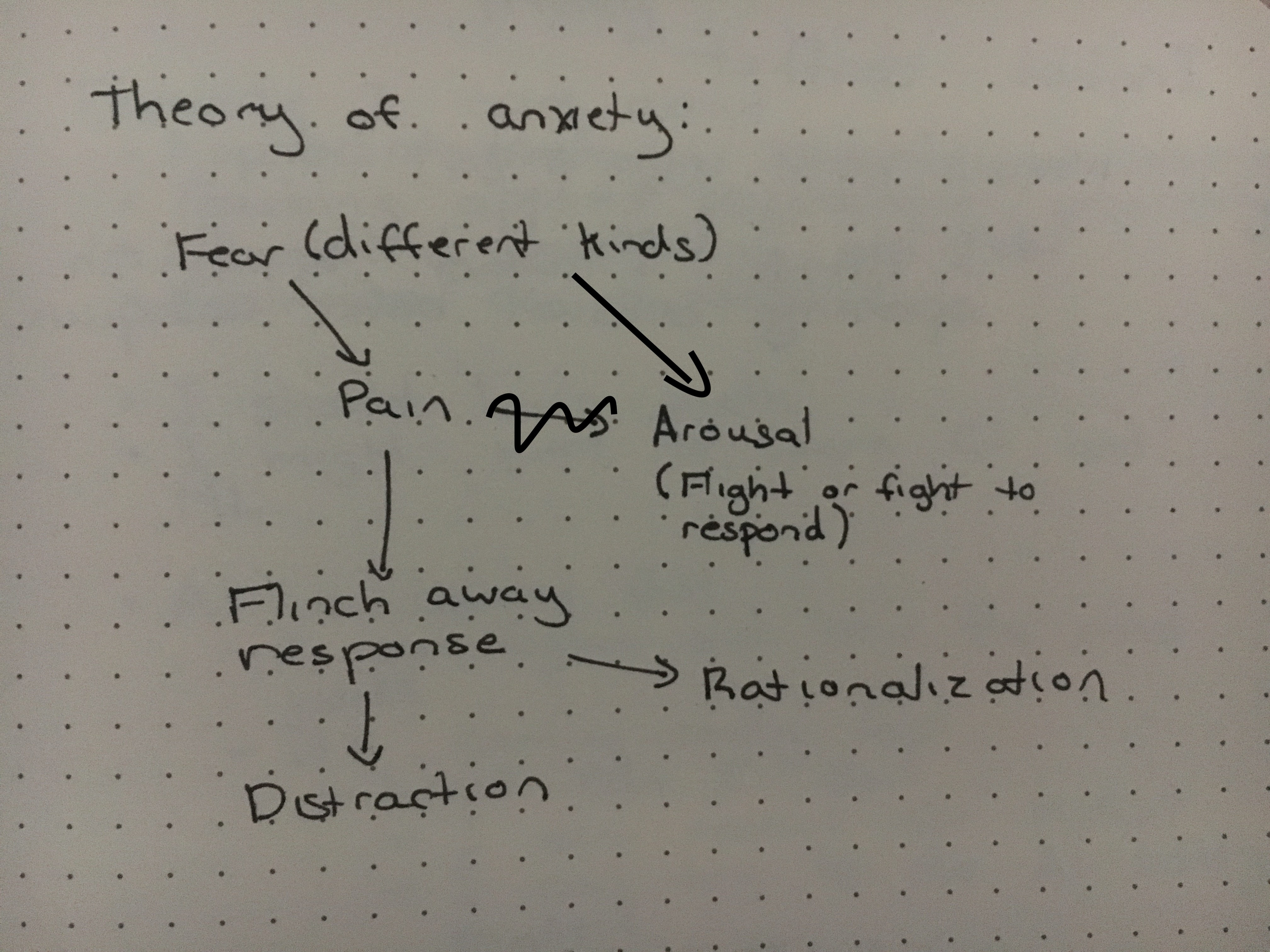
Basically, the state that I’m calling anxiety is characterized by two responses moving “perpendicular” to each other: increased physiological arousal, mobilizing for action, and a flinch response redirecting attention to decrease pain.

Here’s the causal diagram:


IMG_2554.JPG

The parts of the model

It starts with some fear or belief about the state of the world. Specially, this fear is an alief about an outcome that 1) would be bad and 2) is uncertain.

For instance:

  • Maybe I’ve waited too late to start, and I won’t be able to get the paper in by the deadline.
  • Maybe this workshop won’t be good and I’m going to make a fool of myself.
  • Maybe this post doesn’t make as much sense as I thought.

(I’m not sure about this, but I think that the uncertainty is crucial. At least in my experience, at least some of the time, if there’s certainty about the bad outcome, my resources are mobilized to deal with it. This “mobilization and action” has an intensity to it, but it isn’t anxiety.)

This fear is painful, insofar as it represents the possibility of something bad happening to you or your goals.

The fear triggers physiological arousal, or SNS activation. You become “energized”. This is part of your mind getting you ready to act, activating the fight-or-flight response, to deal with the possible bad-thing.

(Note: I originally drew the diagram with the pain causing the arousal. My current guess is that it makes more sense to talk about the fear causing the arousal directly. Pain doesn’t trigger fight-or-flight responses (think about being stabbed, or having a stomach ache). It’s when their’s danger, but not certain harm, that we get ready to move.)

However, because the fear includes pain, there are other parts of the mind that have a flinch response. There’s a sub-verbal reflex away from the painful fear-thought.

In particular, there’s often an urge towards distraction. Distractions like…

  • Flipping to facebook
  • Flipping to LessWrong
  • Flipping to Youtube
  • Flipping to [webcomic of your choice]
  • Flipping over to look at your finances
  • Going to get something to eat
  • Going to the bathroom
  • Walking around “thinking about something”

This is often accompanied by rationalization thought, that is justifying the distraction behavior to yourself.

So we end up with the fear causing both high levels of physiological SNS activation, and distraction behaviors.

Consequences

The distraction-seeking is what gives rise to the “reactivity” (I should write about this sometime) of anxiety, and the heightened SNS gives rise to the jittery “high energy” of anxiety.

Of course, these responses work at cross purposes: the SNS energy is mobilizing for action, (and will be released when action has been taken and the situation is improved) and and the flinch is trying not to think the bad possibility.

I think the heightened physiological arousal might be part of why  anxiety is hard to dialogue with. Doing focusing requires (? Is helped by?) calm and relaxation.

I think this might also explain a phenomenon that I’ve observed in myself: both watching TV and masturbating defuse anxiety. (That is, I can be highly anxious and unproductive, but if if I watch youtube clips for and hour and a half, or masturbate, I’ll feel more settled and able to focus afterwards).

This might be because both of these activities can grab my attention so that I loose track of the originating fear thought, but I don’t think that’s right. I think that these activities just defuse the heightened SNS, which clears space so that I can orient on making progress.

This suggests that any activity that reduces my SNS activation will be similarly effective. That matches my experience (exercise, for instance, is a standard excellent response to anxiety), but I’ll want to play with modulating my physiological arousal a bit and see.

Note for application

In case this isn’t obvious from the post, this model suggests that you want to learn to notice your flinches and (the easier one) your distraction behaviors, so that they can be triggers for self-dialogue. If you’re looking to increase your productivity, this is one of the huge improvements that is on the table for many people. (I’ll maybe say more about this sometime.)

Some ways to “clear space”

[Epistemic status: pursuing ideas, no clear conclusion]

Part of the thinking of my Psychology and Phenomenology of Productivity

Followup to: What to do with should/flinches: TDT-stable internal incentives

So there’s a problem.  When I’m agitated, the thing that most helps is doing Focusing on the agitation, to dialogue with it and get clarity about which goals are threatened. But when I’m most agitated, my mind tends to glance off of my agitation. I can’t stabilize my intention on the agitation enough to start doing Focusing.

So I have a circular dependency. I want to do Focusing, to help the agitation. I can’t do Focusing, because I’m agitated.

I think resolving this is what is meant by the “clearing a space” step in Gendlin’s 6 steps, and may be isomorphic to “unblending”.

Personally, I really want to have a systematic solution to this problem.

These are somethings that I know help boost me out of the circular dependency.

  • Grab another person to be my focusing companion. This one helps hugely, for reasons that are unknown to me. (Extra working memory? I don’t think that’s it. Maybe, having another person looking at me creates a slight pressure towards coherent trains of thought, instead of my mind/attention jumping around from stimulus to stimulus? That seems closer.
  • Start writing. This seems like it also anchors my attention, so that it’s easier to be in contact with the anxiety/agitation, without slipping off.

These are some things that might help, but I haven’t tried in depth yet.

  • Some explicit practice with the unblending step of Focusing? (It’s my understanding that some Focusing teachers train this explicitly
  • Top down regulating my SNS activity using something like Val’s old Againstness, or my suggestion serenity routine from 2014?


Note that I need my solution that itself avoids the problem of the circular dependency. Whatever the technique I use to to make space to do Focusing on the agitation has to be easy to do when agitated, or what’s the point?

But ideally, I could have a TAP sequence that looked like…

[Notice the agitation] -> [Snap my fingers (or something, to reify and time-condence the noticing] -> [Clear space somehow] -> [Do Focusing on the root of my agitation]