Emotional misattribution? Mental structures you can access from states

In my recent post on possible interventions on physiological arousal, there’s something interesting about two of the approaches that felt most promising to me.

Both singing and exercising involve going with the flow, or moving in the same “direction” as the arousal. In both cases, you lean into the activation, but you apply a new meaning to it, or reinterpret it, or repurpose it, or something.

In the case of singing: I feel agitated about something and my physiology is activated. I sing some folk songs, really feeling into the emotions and the meaning they embody. After doing that for a bit the arousal exhausts itself, and I’m calmer or more settled.

It similar in the case of exercising: I’m agitated, I pour that excess energy into working out, and I expend that energy.

In fact, while we’re at it, in the past, I’ve noted before that masturbation / ejaculation seems to have a similar impact.

The last two are less confusing / surprising, because they seem like they involve hormonal shifts / the literal expending of chemical energy. But what’s happening in the case of singing? There’s some, goal structure / meaning, some reason why I’m aroused / agitated / activated, I take that activation and “apply” it to a totally separate goal structure / meaning, I “resolve” this new goal structure, and my system calms down as if it just forgets what caused it to be agitated in the first place.

That seems kind of weird. You’d think that if my body thought that there was some reason to be energized, and I added a second reason to be energized, but then resolve that second reason, I should still be energized, because nothing has changed about reason #1.

But I guess it doesn’t work that way.

It seems more like there’s a two way information flow between mental content and physiological state, and each one informs the other. (I think “informs” is exactly the right word. Each one is updating on the outputs of the other, my body responding to my thoughts, and my thoughts responding to my body.) So if I’m agitated, and I try to shift my thoughts to something non-agitating, this force-against-force, my mind is resisting, on the basis of my bodily activation. But I can easily swap out a different agitating / activating thought structure, without any resistance at all. And apparently, the whole system doesn’t have enough “working memory” to track two meanings at once, and so the original gets dropped.

I suspect that this phenomenon might be pretty general, that it applies to a bunch of different emotional/physiological states, not just arousal. I was in a circle once, when I was really sad about one thing, and then I found myself crying about (and feeling some catharsis around) some other sad thing.

In fact, I think in general, when I’m feeling sad, I tend to associate it with my romantic loneliness, out of something like habit, even if my romantic situation didn’t have much to do with why I was feeling down.

I postulate that when you’re in a given physiological state, you have ready access to all (?) of the meaning-structures (whatever that means), that are “attuned to” (whatever that means), that state. So when you’re sad, you can access all of the reasons / narratives to be sad (although maybe only one at a time?), and when you’re excited you can access all of the reasons / narratives to be happy.

[I wonder if this has anything to do with why depression is resilient. Maybe people slip into a depressed state, and they access / slide into a meaning structure that they’re used to remunerating on, which unfortunately, is very robust, and so they get stuck in their depressed state.  That is, when a person is depressed they are accidentally doing the opposite of the trick I described above, instead of switching to a meaning that they can resolve, thereby exiting the state, they switch to a meaning that is particularly hard to resolve.]

This is in some sense just a restatement of the concept of “emotional misattribution”, but it seem importantly different in framing somehow.


The Basic Intervention Set for Productive Flow, and That, Generalized

[Epistemic status: Sketch. I could write this post in a lot more detail, delving in the specifics of what I mean and being a lot more rigorous, but I’m opting for a quick and dirty outline that hopefully gestures in the right direction. Plus, I’m still figuring out some of the details.]

Related to: My personal wellbeing support pillars

The Basic intervention Set for my Personal Productivity

Lately, I’ve been writing a book (or something) about the psychology and phenomenology of personal productivity, and designing a complete, robust system, for maintaining high levels of productivity sustainably. In that text, I go into a lot of detail about the a fairly large number of policies and procedures.

But in thinking about implementing this system, I recently asked myself “what are the most basic, most important pieces? Which habits are crucial, in their support of making everything else work? Which things should I make sure happen every day?”

This is the list I came up with:

  1. Prioritize sleep: Sleep well and long every night, and if that fails for some reason, make up the difference with a nap in the afternoon.
  2. Exercise everyday (which in practice, means having an exercise TAP, or a suite of exercise TAPs).
  3. Outline my day, everyday (part of an evening routine).
  4. Have free space (on the order of two hours) at the end of every day,
  5. Reliably transition to a Focusing Process when I experience aversion or anxiety.

(This is missing somethings that are obviously crucial, but I mostly don’t worry much about any more, like having a system to keep track of everything the I need to do without using my head, or not overeating. I these are issues that I used to have, but are now robustly taken care of.)

Generalizing

Looking at this list, I can generalize each item: I don’t care about sleep for it’s own sake, I care about my level of mental energy and focus. This is important to note, because sometimes I’ll have missed the boat on good sleep, and knowing what sleep is in service of lets me find other ways to meet that goal.

(Similarly, having a TAP to get paper, when your working memory is overwhelmed is excellent, but you want to understand the mechanism by which paper helps. Otherwise you might find yourself without any paper, and not realize that ducking with a buddy might also help you.)

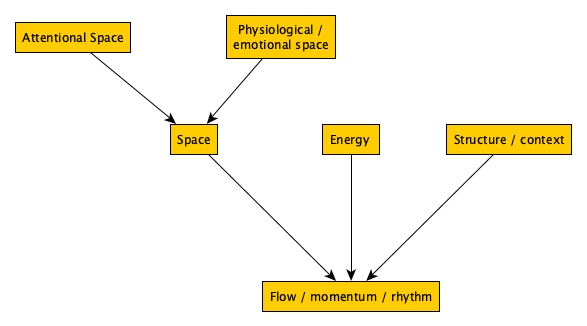
Generalizing in that spirit, it seems like there are three phenomenological states that are contributing to a final goal:

  1.  Space or spaciousness, both
    1. Attentional space, and
    2. Physiological / emotional space
  2. Mental energy
  3. Structure / nudges / goals loaded up / context

All of which together create or support something like

4. Flow / momentum / rhythm

2019-12-05 Space, energy, structure

I tentatively claim that if the first three are present, the fourth deterministically follows.

Elaborating on each

These breakdowns are first and foremost phenomenological categories. The important thing is that they feel like distinct states from the inside. I might additionally have theories about the mechanisms that give rise to those states, or how these states give rise to other states further downsteam, but the fundamental thing is the first person experience.

Space

Or internal space. The feeling of not being distracted, or yanked around, or whatever. Not feeling pressured. Not being harried or rushed.

Related to what I called metacognitive space, but I think metacognitve space is actaully the combination of space and structure.

I break down internal space into space of two kinds (which are probably quite interrelated):

Attentional space is freedom from distraction, meaning both people coming and bothering you, and little nagging pings about things that you need to deal with. GTD is aimed at creating this kind of space.

Physiological / emotional space is related to Focusing. Your attentional space can be eaten by some nagging thought. Your physiological / emotional space can be taken up by some unmet need or unhandled goal which is manifesting as a felt sense in the body. This can be just as distracting.

[Actually I think this might still be conflating two things. I can have space in the sense of “there’s no pressing need in my felt sense center”, and I can have space in the sense of “there is a pressing need, but I have some distance from it, and am not blended with it or acting compulsively from it.” I think those are importantly different. Note to reader: I’m still confused about this one and. I should figure how how those pieces all fit together.]

Mental energy

The thing I was talking about here and here. I currently define it as “in practice willingness to exert cognitive effort.” The more your mental energy is topped off the more effortless it is to do demanding cognitive work. To the extent that you’re running low on cognitive energy, doing work feels force-y.

Good sleep is crucial for this, and regular exercise also seems to help.

Context

Even having both space and energy, my hours may not be automatically spent on progress towards my goals. I need to have my goals (or tasks) “loaded up” in my attentional space in order for me to automatically take action on them.

I think this is why scheduling my day is so helpful, among other reasons: it primes me with some mental context about what I care about and what needs to be done.

Flow / rhythm

This is what it feels like when I’m clipping along, smoothly moving from one task to the next. There’s no impediment. There’s a slight pressure, like a forewind pushing me forward. There’s momentum to it. I don’t have to force, the natural thing to do is just the next thing that needs doing.

2019-12-05 Space, energy, structure (with interventions)

I actually don’t know how reserving 2 hours at the end of day during which I have no obligations and I’m not trying to do anything in particular fits into this. Naively, it seems like it would contribute to spaciousness, in the same way that meditation is. But it also seems like it actually buys me energy, in the same way that a rest day buys me energy.

I think that taking time with no obligations actually buys me space in the sense of space between stimulus and response / being able to take things as object, as opposed to either attentional or physiological/ emotional space.

Some musings about exercise and time discount rates

[Epistemic status: a half-thought, which I started on earlier today, and which might or might not be a full thought by the time I finish writing this post.]

I’ve long counted exercise as an important component of my overall productivity and functionality. But over the past months my exercise habit has slipped some, without apparent detriment to my focus or productivity. But this week, after coming back from a workshop, my focus and productivity haven’t really booted up.

Here’s a possible story:

Exercise (and maybe mediation) expands the effective time-horizon of my motivation system. By default, I will fall towards attractors of immediate gratification and impulsive action, but after I exercise, I tend to be tracking, and to be motivated by, progress on my longer term goals. [1]

When I am already in the midst of work: my goals are loaded up and the goal threads are primed in short term memory, this sort of short term compulsiveness causes me to fall towards task completion: I feel slightly obsessed about finishing what I’m working on.

But if I’m not already in the stream of work, seeking immediate gratification instead drives me to youtube and web comics and whatever. (Although it is important to note that I did switch my non self tracking web usage to Firefox this week, and I don’t have my usual blockers for youtube and for SMBC set up yet. That might totally account for the effect that I’m describing here.)

In short, when I’m not exercising enough, I have less meta cognitive space for directing my attention and choosing what is best do do. But if I’m in the stream of work already, I need that meta cognitive space less: because I’ll default to doing more of what I’m working on. (Though, I think that I do end up getting obsessed with overall less important things, compared to when I am maintaining metacognitive space). Exercise is most important for booting up and setting myself up to direct my energies.


[1] This might be due to a number of mechanisms:

  • Maybe the physical endorphin effect of exercise has me feeling good, and so my desire for immediate pleasure is sated, freeing up resources for longer term goals.
  • Or maybe exercise involves engaging in intimidate discomfort for the sake of future payoff, and this shifts my “time horizon set point” or something. (Or maybe it’s that exercise is downstream of that change in set point.)
    • If meditation also has this time-horizon shifting effect, that would be evidence for this hypothesis.
    • Also if fasting has this effect.
  • Or maybe, it’s the combination of both of the above: engaging in delayed gratification, with a viscerally experienced payoff, temporarily retrains my motivation system for that kind of thing.)
  • Or something else.